
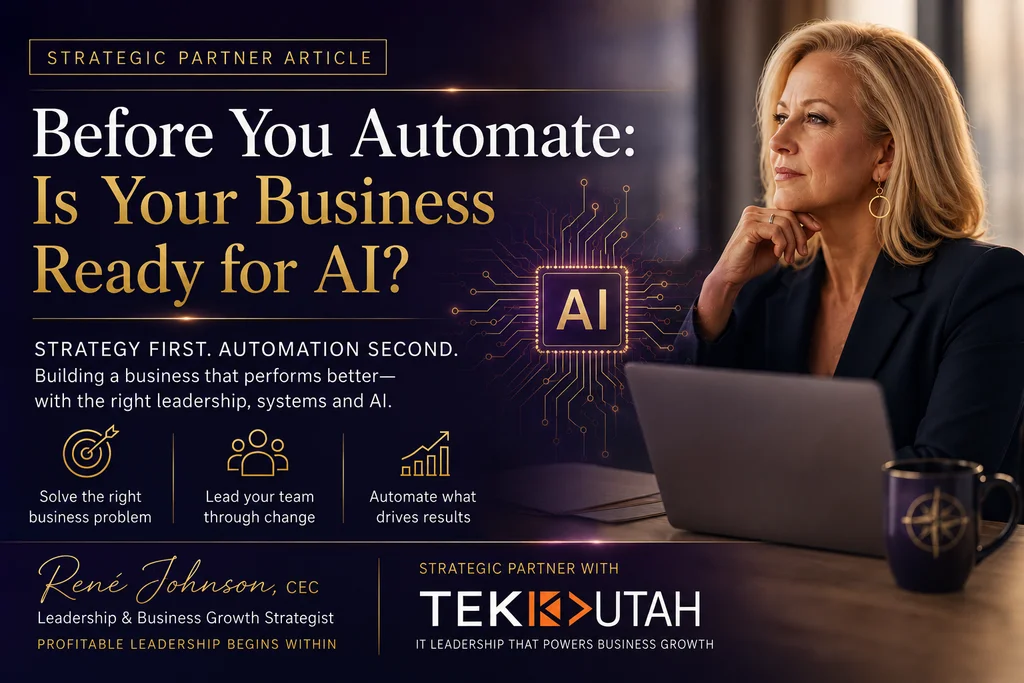
AI is Everywhere
Business leaders are being told they need to adopt it, automate with it, train their teams on it—and move quickly or risk being left behind.
I agree that AI represents an incredible opportunity. I use it in my own business, and I’m continually exploring how it can help leaders and their teams save time, improve performance, make better decisions, and grow more profitably.
But I also believe we’re starting with the wrong question.
Instead of asking:
“What can we automate with AI?”
I encourage leaders first to ask:
“What in our business actually needs to work better?”
Because automating an inefficient, inaccurate, or unprofitable process doesn’t solve the problem. It may simply allow you to do the wrong thing faster.
That’s why I believe successful AI adoption starts with business strategy—not technology.
1. Before You Automate, Evaluate
In my work with business owners and executive teams, I help leaders identify what I call Power Profit Leaks™—the gaps in leadership, systems, people, and execution that quietly cost a business time, money, capacity, and opportunity.
AI creates exciting possibilities for addressing some of those leaks. But before deciding that automation is the answer, we need to understand the system behind it.
Consider a process your team performs repeatedly. Before automating it, ask:
Is the process efficient? Is it consistently followed? Does everyone understand who owns what? Are there unnecessary steps or bottlenecks? Is it producing an accurate, measurable result? Is it profitable? And which parts require human judgment, relationships, or decision-making that shouldn't be automated?
This is an important distinction.
If five people perform the same process five different ways, automating one version doesn't necessarily improve the business.
First optimize. Then automate.
Sometimes AI will be the solution. Sometimes a better process, clearer accountability, improved training, or a different technology solution will create a greater return.
The goal isn't to use more AI.
The goal is to build a better-performing business.
2. AI Adoption Is a Leadership Challenge, Too
There is another piece of AI adoption that I believe is getting far less attention: your people.
You can purchase an AI application. You can build an automation. You can introduce new technology. That doesn't mean your team will successfully adopt it.
I've spent more than two decades helping business leaders navigate growth and change, and one lesson remains consistent: change doesn't implement itself.
People need to understand why something is changing, how it helps them perform, what is expected of them, and how success will be measured.
With AI, there is an additional layer.
Some employees are excited about it. Others are skeptical. Some are experimenting independently with AI tools without clear company guidelines. Others may worry that AI will eventually replace their jobs.
Leadership matters tremendously here.
Successful AI adoption requires communication, expectations, accountability, training, and trust. Leaders also need to determine where AI enhances human performance—and where human expertise, judgment and relationships remain essential.
The businesses that gain the greatest advantage from AI won't necessarily be those with the most AI tools.
I believe they will be the businesses whose leaders intentionally align people, process, and technology around a clear business outcome.
3. Start With the Business Problem—Not the AI Tool
This brings us back to where I believe the conversation should begin. Rather than asking:
“What can AI automate in my business?”
Try asking:
“Where are we losing time, money, capacity, or consistency—and could AI help us solve it?”
That question creates a very different conversation.
- Perhaps your team spends hours every week manually transferring information between systems.
- Maybe client follow-up is inconsistent.
- Perhaps leaders are spending valuable time performing administrative tasks that don't require their expertise.
- Maybe reporting takes hours to compile even though the information could be surfaced much faster.
- Or perhaps the real issue isn't automation at all. It may be an unclear process, a lack of accountability, or a system that needs to be redesigned before technology is added.
This is where business strategy and technology strategy need to come together.
The Opportunity Ahead
Eric Thorup and I have been exploring this intersection together: How do we help business leaders adopt AI strategically rather than simply adding more technology?
We're currently developing ideas around an AI adoption and automation strategy that combines the business and leadership side of change with TEK Utah's technology expertise.
The vision is to help businesses evaluate the systems and processes they want to improve, identify meaningful opportunities for AI and automation, assess potential returns, and prepare leaders and teams to successfully adopt the changes that make sense.
We're intentionally not starting with a predetermined AI tool or automation.
We're starting with your business.
- Where are the Power Profit Leaks™?
- What isn't working as efficiently as it should?
- Where is your team losing valuable time?
- What could become more accurate, consistent, or profitable?
And then—where can AI meaningfully help?
If AI is on your radar but you're not sure where to begin, I invite you to start with a With a Complimentary Strategy Call with me.
We'll look at your current business priorities, identify potential Power Profit Leaks™, and explore where your systems, leadership, or team may have opportunities for improvement.
And when we uncover an opportunity where AI, automation, or other technologies may be part of the solution, we can bring my trusted partner, Eric, and TEK Utah into the conversation to leverage his expertise and explore the possibilities together.
Because AI shouldn't simply make your business more automated.
It should help you build a business that performs better.
René Johnson, The Power Zone Coach
Founder & CEO, Power Zone Coaching, LLC
Leadership & Business Growth Advisor
*By invitation of Eric Thorup and TEK Utah, René Johnson, Founder of Power Zone Coaching, shares a business leadership perspective on AI adoption—and why the smartest place to begin may not be with AI at all.